Alien and my Work
Written January 27th 2025
In this essay, I am going to compare my own photos in the project un jour je serai complete with the work of HR Giger, specifically the visual style used in the 1979 film Alien. I will be talking about various visual parallels that can be drawn throughout the film with my work, then I will expand into talking about the ‘biomechanism’ style that Giger specialised in. I will go into detail about the use of phallic imagery and other imagery that is reminiscent of sexual organs through both pieces of work. Then about how Trypophobia (the fear of dimples or holes on a surface) is used by both my work and the film to accentuate the horror. I will then talk about abjection and how it is used in the chest burster scene of Alien versus how my own work relates to Julia Kristeva’s Powers of Horror essay. After that I intend to delve further into HR Giger’s own artwork and analyse some of the similarities between that and my photobook. Then finally, I will talk about the idea of gender performance in Alien and how linked it is with the gender performance I used in my project.
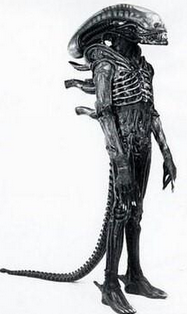
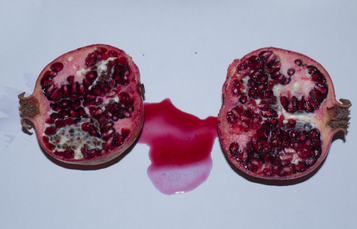
To start, I want to look at the above image from my project. It depicts a pomegranate cut in half on a white background, with the juice trailing out of each half and converging. The use of a pomegranate was intentional to reference the mythological significance of the pomegranate, symbolising femininity and transformation - which works well in a project showing my relationship with my femininity and my transness. With this image, the shape of the juice spill is not dissimilar from the shape of ovaries. Referencing sexual organs through imagery is something that Alien uses to enhance metaphors and symbolisms already present in the film. The most obvious comment to make regarding the appearance of the alien, would be its head’s phallic shape, as well as the additional phallic appendage it has inside its mouth used to kill its victims. This excerpt from an article written by Derek Jacobs in his blog words this as such – ‘The phallic strength of the Xenomorph is now hyper-represented by the pharyngeal jaws: an extension of the already phallic head which is literally used to penetrate its victims to death’ [1]. This consistent use of phallic imagery throughout the film helps carry the overall commentary on gender in the film, allowing there to be a role reversal of sorts, where the men on the ship are being hunted by a predator as well as the women. In my project, the use of ovaries references ‘traditional’ femininity and contorts it, with the uneven and grotesque innards of the pomegranate being visible. In the wider project, much like Alien, this helps to build a criticism of the current order of gender by changing or contorting what are seen as symbols or roles of certain genders.
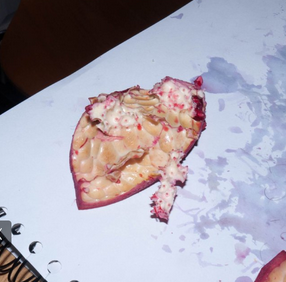
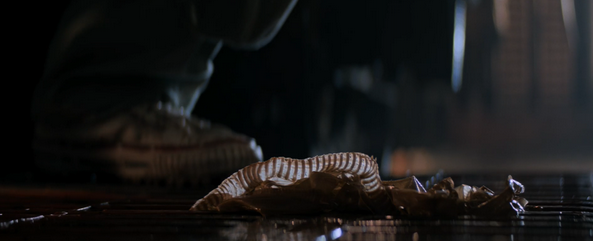
Next, I will talk about how both Alien and my project evoke Trypophobia (‘[referring] to a strong fear of closely packed holes’ [2]) through their imagery (specifically as shown in these two images), as well as what this specific fear means in their respective pieces of media. A case report and review by Martínez-Aguayo et al. published in Frontiers in Psychiatry, concludes that there are two possible evolutional explanations put forward for the existence of Trypophobia. The case report says ‘trypophobia could be a product of evolution, an aversion to poisonous animals that possess high-contrast energy at midrange spatial frequencies in their skin’ or that it could be ‘due to an aversion to clusters of pustules or roughly circular shapes on human skin, thus helping humans to avoid ectoparasites and infectious diseases’ [3]. I would say that Alien’s use of this fear would fit better into the first possible source, as there is an animal predator at play here, making it the better link of the two. Meanwhile my project’s use of the fear is more applicable to the second possible source concluded by the review, since the body horror in my project focuses on the concept of being uncomfortable in one’s skin, the pomegranate skin’s large dimples were photographed to evoke this fear, as if it were pustules on the skin. In addition, the images both from Alien and my project use the fact that the object in question is skin coloured to add a sense of unease – these objects look nothing like skin should, so it’s again that contortion of common, known things such as the sensation of one’s own skin, that makes this type of horror effective.
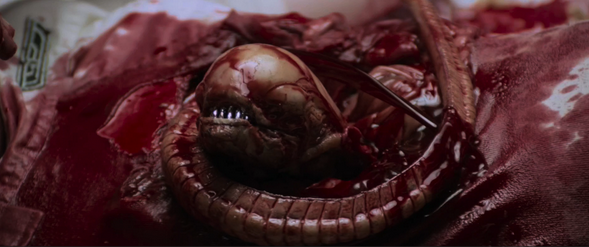
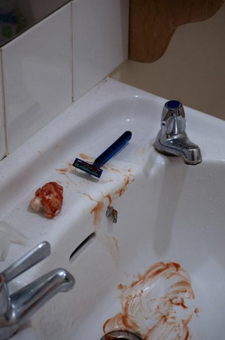
Next, I want to talk about the chest burster scene in Alien and compare it to the blood image from my project. Even though it is more applicable to the former, it could be argued that both examples use the concept of Abjection to evoke horror in the viewer. Abjection refers to our disgust and aversion to things that threaten the boundary between ourselves and the outer world. Vomit, waste and bleeding are all examples of the abject as they transcend the boundary between being inside or outside someone. The use of abjection is more obvious in the scene in the movie, as an alien (in both meanings of the word) being is implanted into Kane with it eventually breaking free, blurring the boundary between the self and the other. In my own work however, the use of abjection is slightly harder to grasp. My work is easier related to Julia Kristeva’s approach to abjection in her essay Powers of Horror. It is summarised well by Dr Sophie Raine, that ‘we construct our identity, Kristeva suggests, based upon the boundaries we set between the self and the other’[4], this is highly relevant to a piece of work such as my own, grounded in the themes of anxiety, body horror and shedding blood to make oneself happy with their appearance. This inferred shedding of blood in my project, according to Kristeva could be read as a process of purification: ‘These body fluids, this defilement, this shit are what life withstands, hardly and with difficulty, on the part of death. There, I am at the border of my condition as a living being. My body extricates itself, as being alive, from that border. Such wastes drop so that I might live, until, from loss to loss, nothing remains in me and my entire body falls beyond the limit—cadere, cadaver’[5]. I read this quote, in the context of the work, that I shed blood through shaving, in order to make my body appealing to myself – the hair and the accidental spilt blood while shaving is the metaphorical ‘shit’ that Kristeva talks of, that I am ridding myself of in order to be happy.
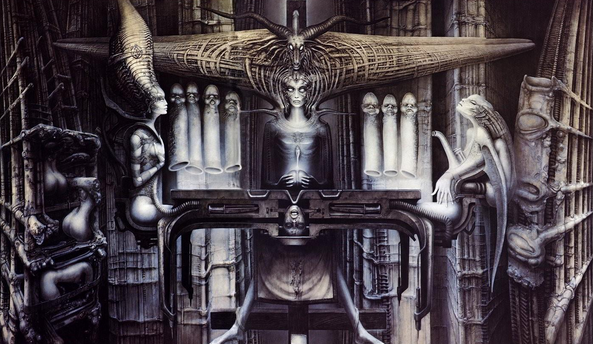
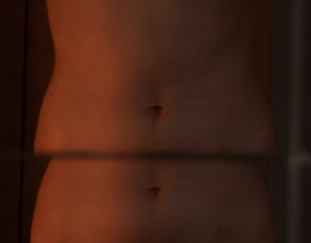
It may also be worth looking at the way that HR Giger’s individual artworks look at gender, gender presentation and phallic imagery. In his Spell II artwork, as can be seen, there is a lot of visual similarities to the interior of the alien ship in the film- the spine-like structure on the far right of the image, or the general textures found around the image. Off to the sides from the centre there are phallic shapes reminiscent of condoms, not dissimilar from the rubbery skin that the baby xenomorph drops off, as mentioned previously. The image depicts three figures that look feminine, yet something is off with each of them – this artwork portrays femininity being something more illusive than simple stereotypical feminine traits, suggesting that it is more than a sum of its parts. Much like that, my photo project uses distortions of myself in the mirror while nude to show how I accept my femininity- not because I look a certain way, but instead because I decide what traits are feminine to me, transcending the presumptions society makes about people’s gender identity based on their body shapes.
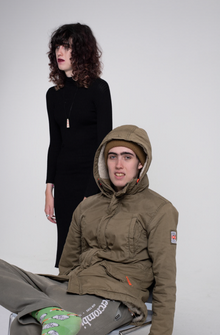
Finally, for this last point I want to focus not on the Xenomorph itself, but on the main character, Ripley. Throughout the film, she acts traditionally masculine, taking lead of the crew of the Nostromo, wearing very stereotypically masculine clothes to reflect this. At the end, when on the escape shuttle, she changes into just being in her underwear as if to symbolise that the traditionally masculine act of leading and being decisive is merely a performance, as femininity is also. This idea of gender presentation being a performance is also reflected in my own project, specifically in the image on the left. For a portion of this project, I was trying to depict two separate characters: the person I used to be and the person I am now – going from there to evaluate the relationship between the two. The masculine persona I put on in the images wears many layers and a fake smile, despite the entire presentation being a façade, as it was for me pre-transition. Compared with that, the hyperfeminine persona I put on in the project is sullen and vulnerable, wearing only one layer, entirely exposed to the world. This use of clothing is similar to how I previously described the idea of gender performance in Alien, with Ripley’s clothing.
Alien is a masterpiece in making an enjoyable horror movie that is also full of meaning and symbolism, I was inspired by it for the creation of my project. Even though in the current day, the Alien franchise has had a run of average at best films, the original film’s legacy remains untarnished. Horror films and horror media in general have changed massively since the release of the film and even where its sequels struggle to replicate its success, other horror films with just as much social commentary and meaning have come out in the years between. Some good examples being Audition (1999), Nope (2022) or Raw (2016) – and even though my project is not comparable in quality to the original Alien film, many of the methods used to carry its meaning were important in the creation of my project.
Bibliography
[1] Jacobs, D. (2016) How To Develop Theme: The Perversion of Sex in “Alien”. Plot and Theme [blog]. 18 May. Available from: https://plotandtheme.com/2016/05/18/the-xenomorph-and-the-perversion-of-sex-in-alien/ [Accessed 22 January 2025].
[2] Healthline (2023) Everything You Need to Know About Trypophobia (Fear of Holes). Available from: https://www.healthline.com/health/trypophobia [Accessed 22 January 2025].
[3] Martínez-Aguayo, JC. et al (2018) Trypophobia: What Do We Know So Far? A Case Report and Comprehensive Review of the Literature. Frontiers in Psychiatry [online]. 9. [Accessed 22 January 2025].
[4] Raine, S. (2024) What is 'The Abject' & Abjection Theory?, Available from: https://www.perlego.com/knowledge/study-guides/what-is-abjection/ [Accessed 23 January 2025].
[5] Kristeva, J. (1980) Powers of Horror [online]. New York City: Columbia University Press. [Accessed 23 January 2025].